Article
Apr 4, 2026
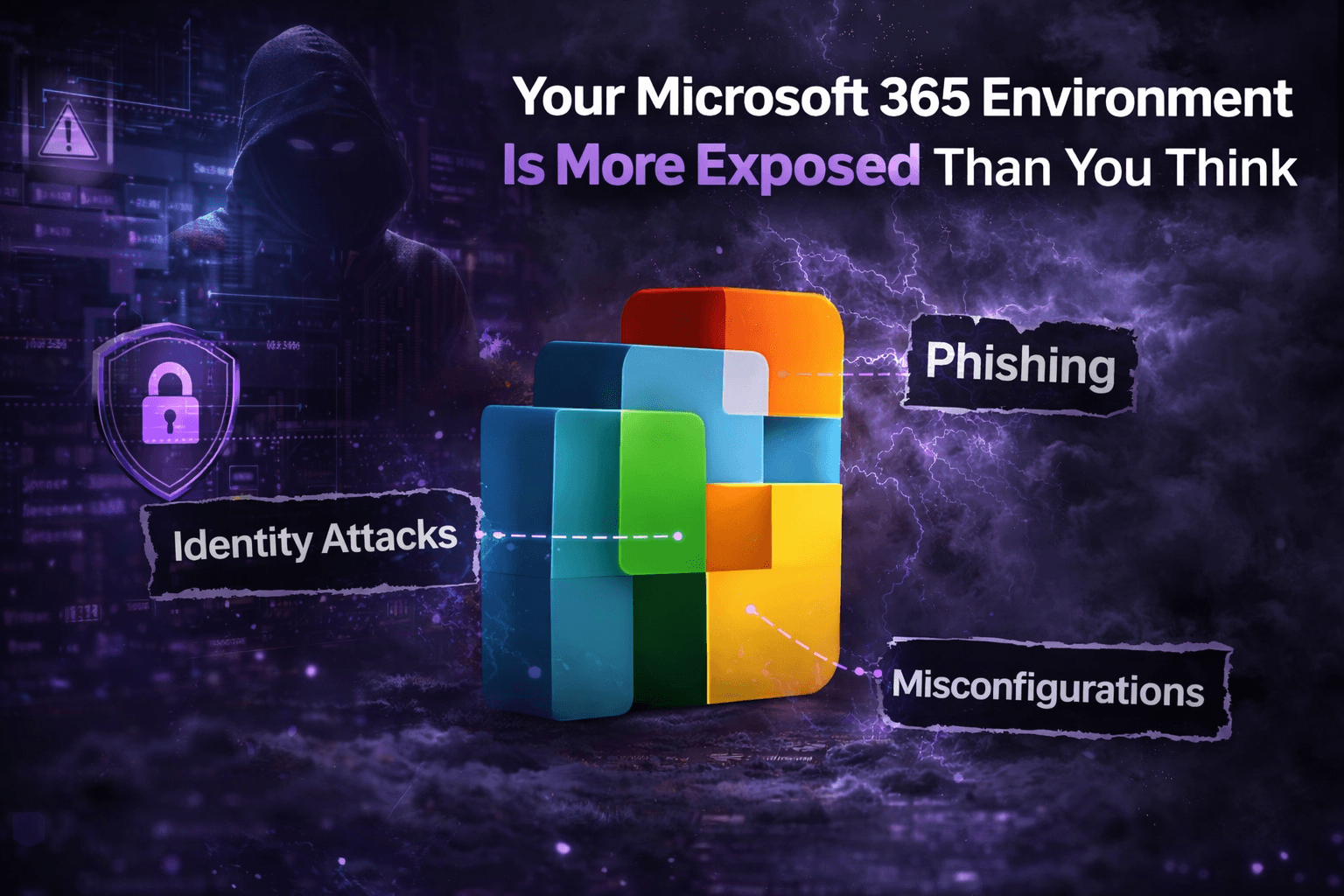
Your Microsoft 365 Environment Is More Exposed Than You Think
Most organizations assume Microsoft 365 is secure by default. In reality, attackers actively target identity, sessions, and misconfigured access controls. Here’s where your environment is likely exposed and how those gaps are exploited.
Introduction
Microsoft 365 is one of the most targeted environments in modern cyber attacks. Many organizations assume that because they are using Microsoft’s platform, their data and users are inherently protected.
That assumption is dangerous.
Attackers are not breaking into Microsoft. They are logging into your environment using valid credentials, stolen sessions, and weak configurations. The majority of successful attacks today are identity-based, not infrastructure-based.
If your Microsoft 365 environment is not properly secured, you are likely more exposed than you think.
1. Identity Is the New Attack Surface
Traditional security focused on endpoints and networks. Today, attackers focus on identity.
If an attacker gains access to a user account, especially one with elevated privileges, they can:
Access sensitive data
Send phishing emails internally
Create persistence mechanisms
Move laterally across your environment
No malware required.
This is why account takeovers are one of the most common and damaging attack vectors in Microsoft 365.
2. MFA Alone Is Not Enough
Many organizations believe that enabling MFA solves the problem.
It does not.
Attackers routinely bypass MFA using:
MFA fatigue attacks (spamming push notifications)
Adversary-in-the-middle phishing kits
Token theft and session hijacking
Once a session token is stolen, MFA is no longer required.
Without proper conditional access policies and session controls, MFA becomes a checkbox rather than a defense.
3. Conditional Access Misconfigurations
Conditional Access is one of the most powerful controls in Microsoft 365, but it is often misconfigured.
Common issues include:
Policies that do not apply to all users
Legacy authentication still enabled
Lack of location or device-based restrictions
Overly permissive access rules
These gaps allow attackers to authenticate from unknown devices, foreign locations, and risky networks without being blocked.
4. Lack of Visibility Into Identity Activity
Many organizations do not actively monitor:
Sign-in logs
Risky user behavior
Impossible travel events
Suspicious session activity
Without visibility, attacks go unnoticed.
Attackers can remain in an environment for days or weeks without detection, increasing the impact of the breach.
5. Privileged Accounts Are Often Overlooked
Global admins and privileged roles are prime targets.
If compromised, an attacker can:
Disable security controls
Create new admin accounts
Grant permissions to malicious applications
Maintain long-term persistence
Many environments have:
Too many global admins
No just-in-time access controls
No monitoring of privileged activity
This creates a high-risk exposure point.
6. Email and Phishing Still Drive Initial Access
Microsoft 365 environments are heavily targeted through phishing.
Attackers use:
Fake login pages
OAuth app consent attacks
Malicious inbox rules
Once inside, they often:
Set up forwarding rules
Monitor communications
Launch business email compromise attacks
These attacks do not always trigger traditional alerts.
7. No Real Incident Response Capability
One of the biggest gaps is not detection. It is response.
Many organizations rely on:
Alerts without action
Delayed escalation
Fragmented responsibility across teams
When an incident occurs, minutes matter.
Without immediate containment, attackers can:
Expand access
Exfiltrate data
Establish persistence
The difference between a contained incident and a full breach is often response time.
What This Means for Your Organization
If you are using Microsoft 365, you are already a target.
The question is not whether attackers will attempt access. It is whether your environment is prepared to detect and stop them.
Most environments are not.
How to Reduce Your Exposure
To reduce risk, organizations need to focus on:
Strong conditional access policies
Continuous identity monitoring
Session and token protection
Privileged access management
Real-time incident response capability
Security is not just about prevention. It is about detection and response.
Final Thoughts
Microsoft 365 is powerful, but it is not secure by default.
Attackers are not breaking in. They are logging in.
If your organization does not have visibility into identity activity or the ability to respond quickly, your environment is more exposed than you think.
Integrating AI tools into your business can significantly enhance efficiency, reduce costs, and improve customer experiences. From automating customer interactions to securing your data, AI is a game-changer for businesses of all sizes. The sooner you implement these tools, the better positioned your business will be for future growth.